Skip to content
Lidyos
Quality & HSE

QualityFrom inspection to corrective action, quality on record.

Inspection plans and lots, control charts, nonconformities and CAPA, certificates of analysis, controlled documents and recalls in one app; for food producers, HACCP, hygiene and food defence are here too. The record the auditor asks for is not searched for, it is opened.

  • 7 sub-modules
  • 24 modules at the same price

Industries: Machinery, metal and automotive suppliers · Textiles and apparel · Chemicals, plastics and cosmetics · Food and beverage

Roles: Production operator · Quality specialist · Shift supervisor · R&D specialist
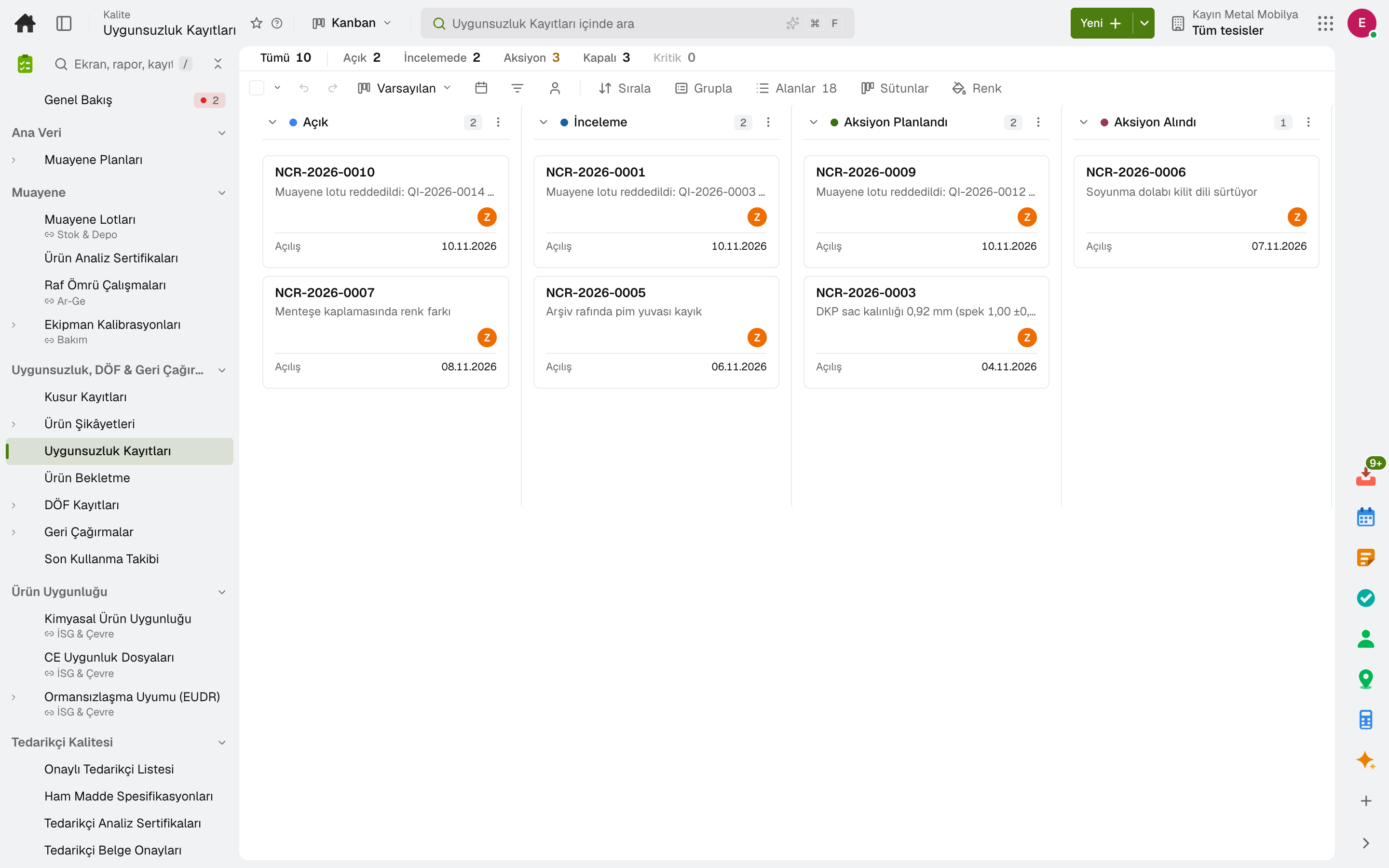
NCR / 8D
Screen in the product
  • NCR / 8D

What is it, and why do you need it?

What is Quality for?

When quality records are kept on paper forms and scattered spreadsheets, finding which batch and which raw material a customer complaint came from takes days; records are recompiled before every audit.

Quality links inspection to goods receipt and production, carries nonconformities into CAPA and runs recalls with batch traceability. Supplier documents are tracked by validity, and measurement drift shows early on the control chart.

Scope: Runs quality processes such as inspection, nonconformities, certificates and CAPA.

Highlights

What do you do with Quality?

01

Inspection

Inspection plans (characteristics, tolerances, AQL sampling) and lots, line checks, product certificates of analysis and shelf-life studies.

02

Nonconformities and CAPA

Nonconformity and defect records, customer complaints, corrective and preventive action.

03

Quality performance

Control charts (SPC), cost of quality, management review; controlled documents and read acknowledgements.

04

Recalls

Affected customers are worked out from the batch genealogy and notified; mock recalls can be run too.

05

Supplier quality

Supplier certificates of analysis are compared with the specification automatically; supplier documents go through an approval queue.

06

Food safety

For food producers: HACCP plans and critical control points, hygiene records, environmental sampling, TACCP/VACCP and temperature excursions.

07

Product hold

Product that may be nonconforming is held until a decision is made: batches are locked in stock, and the decision to release, use conditionally, rework, destroy or return is recorded with its reason.

08

Part approval (PPAP)

Quality planning for a new part runs with its phases and phase gates, and the part file submitted to the customer with its 18 elements and submission level; evidence is gathered from the process FMEA and inspection results.

09

Approved supplier list

Approval status per material and supplier: approved, conditionally approved, under evaluation, not approved or suspended; each row states its reason.

Sub-modules

Quality: 7 sub-modules

This list is generated from the product itself; it grows as new functions are added to a sub-module. Master data and settings are the shared ground of every module and are not counted as sub-modules.

Inspection

  • Inspection LotsCreates quality inspection lots and records results.
  • Line ChecksHolds the production line's mandatory checks in seven sections: the line's shift checks (metal detector, critical control point, line hygiene — the line is selected on the tablet, a check not done is counted as missed), shift handovers (quality summary, note and the incoming shift's approval), retained samples kept from batches and their disposal times, periodic checks of glass and hard plastic items, label/allergen/packaging verification per batch, net content measurement of fill samples and panel sensory evaluations.
  • CoA (Certificate)Creates and shares product certificates of analysis (CoA).
  • Shelf Life StudiesConducts product shelf life/stability studies — determines the recommended shelf life using a periodic measurement series.
  • Equipment CalibrationManages the calibration plan and results of equipment and measuring devices.

Food Safety

  • HACCPManages HACCP plans (hazard analysis, critical control points, version), CCP monitoring status, and critical limit deviations on tabs of the same screen.
  • Food HygieneManages line cleaning (CIP) cycles, the cleaning schedule, allergen changeover cleaning, ATP surface tests, and branch temperature records on tabs of the same screen.
  • EM SamplesRuns the environmental monitoring (EM) program on a single screen: records swab samples and enters the lab result (on a positive/over-limit result the mandatory investigation opens automatically; a sample without a result cannot become 'completed'), tracks samples on the calendar, manages sampling points (Zone 1-4, target organism, acceptance limit), positive investigations (root cause, environmental screening, corrective cleaning, Zone 1 batch hold suggestion), and the positive-rate trend by zone/point/organism.
  • Temperature ExcursionsDetects cold chain temperature violations and issues alerts.
  • Food Defense (TACCP/VACCP)Scores TACCP (food defense) and VACCP (food fraud) vulnerabilities by supplier/raw material/plant; the score is a suggestion, the team makes the decision.
  • Food Safety IncidentRecords food safety incidents (HACCP); manages authority notification and recalls.

Nonconformance, CAPA & Recall

  • Defect / NotificationRecords a defect seen at inspection or on the line with lot, defect code, quantity and photo; if the code is flagged for automatic NCR, a nonconformance is opened. Defect codes are defined in Quality Codes.
  • Product ComplaintsThe canonical register of product complaints from consumers (BRCGS complaint record): records them with channel, place of purchase, expiry date and retained-sample link and ties them to a corrective action. A business customer's defective delivery notice is opened in Nonconformity Records with the "customer" source.
  • NCR / 8DManages quality nonconformance reports (NCR).
  • Product HoldsHolds potentially nonconforming product until a decision is made: a critical deviation in a line check puts the affected batches on hold automatically, quality locks the batches in stock and decides release, concession, rework, destruction or return with justification.
  • Quality CAPAManages corrective and preventive actions (CAPA) for quality nonconformities; in the Action Plan section, quality actions derived from the CAPA are tracked by owner and due date.
  • Recall ManagementManages the food recall process: calculates affected customers from the batch genealogy tree, sends notifications, and produces the effectiveness (BRC/IFS) report; in the Drill section, a recall mock exercise (does not send real notifications) that measures time and traceability is run for the selected batch.
  • Expiry TrackingMonitors batches nearing and past their expiry date; flags expired ones, deducts those to be destroyed as bulk scrap, and starts a recall if needed.

Product Compliance

  • Part Approval (PPAP) & APQPRuns quality planning for a new part (APQP: five phases, phase outputs, phase gates) and the part submission for customer approval (PPAP: 18 elements, submission levels 1–5, customer approval · interim approval · rejection); evidence is gathered from the process FMEA, inspection results and process capability (Cpk).
  • Product ComplianceTracks products' REACH/RoHS/KKDIK compliance, SVHC status and validity periods.
  • Product Conformity FilePrepares the CE declaration of conformity per product model: applied legislation and harmonised standards, assessment module and notified body, signatory; risk assessment, test report, technical drawing and user manual in the technical file. For products sold in the EU, the GPSR responsible person and safety warnings; for energy-labelled products, the EPREL registration. When nothing is missing the declaration is published and its Turkish/English PDF is produced; changes are made with a new version, and the declaration is kept for 10 years.
  • Deforestation Due Diligence (EUDR)Runs due diligence for cocoa, coffee, palm oil, soy, cattle, rubber and wood under the EU Deforestation Regulation (2023/1115): in-scope materials are found from the HS code; for every supplier batch you enter the country of origin, the location of the production plot, the production date, proof of no deforestation after 2020-12-31 and the legality document, then country risk and the risk assessment are done; when nothing is missing the DDS reference is recorded and shipments to the EU are linked to this record.

Supplier Quality

  • Approved Supplier ListShows the approval status per material and supplier: approved, conditionally approved, under assessment, unapproved or suspended. The status derives from the block and validity of the quality information record, the approved raw material specification, the validity of supplier documents and the latest certificate of analysis; each row states its reasons.
  • Quality Info RecordDefines the quality info record for the material-supplier pair.
  • Raw Material SpecificationsKeeps the characteristics a supplier guarantees for a raw material (lower/upper limit, expected result, method) versioned per material and supplier; compares each characteristic with the material's inspection plan, shows items that are wider or have no counterpart; quality approves or rejects with a reason, and when a new version is approved, the old one expires.
  • Vendor CoA (Spec Check)Automatically compares the CoA (certificate of analysis) values received from the supplier with the specification limits; on a nonconforming result it opens an NCR review task in quality, and passes a conforming result to the inspection lot as a suggestion.
  • Supplier Document ApprovalsLists documents uploaded by suppliers through the portal in an approval queue; quality approves them or rejects them with a rejection reason.
  • Vendor Quality Score (QM)Scores suppliers by quality performance.

Documents & Training

  • Controlled DocumentsTracks the life cycle of procedure, instruction and form documents in controlled folders (draft → review → approval → effective → obsolete), their effective and review dates, the e-signature manifest and the audit trail, along the quality manager's axes; the file itself is shared with the Documents tool.
  • Read AcknowledgmentsDefines which role must read procedures and instructions; when a revision is published, the relevant staff give an 'I have read and understood' acknowledgment, and who has read / is pending is tracked (GFSI traceability).
  • Quality TrainingsAssigns the curriculum to employees (per person and in bulk from the catalog), tracks certificates and monitors completion status.

Quality Performance

  • AuditsPlans environmental and occupational safety audits and tracks their findings; in the Audit Program section, recurring audits are linked to the plan and created automatically when due; in the Checklist Templates section, the templates used in audits are defined by section and question.
  • SPC / Control ChartStatistically tracks inspection results with control charts (I-MR) and Cp/Cpk.
  • Cost of QualityMeasures prevention, appraisal and failure costs (cost of quality).
  • Management ReviewRecords management review meetings, their inputs and decisions.

Master Data

  • Inspection PlanDefines inspection plans for materials and processes and the plan's master data: characteristics to be measured and their tolerances, inspection methods, sampling procedures (AQL accept/reject, severity) and dynamic sampling rules that adjust inspection frequency based on quality history.
  • Process FMEA (PFMEA)Step-by-step failure mode and effects analysis of production/quality processes (PFMEA, AIAG-VDA): process · step · product · characteristic, severity × occurrence × detection = RPN, action priority (AP), prevention/detection controls and revised ratings — the same engine as maintenance's equipment FMEA.

Setup master data and settings

  • Microbiological CriteriaTurkish Food Codex microbiological criteria: food category, microorganism, sampling plan (n, c), limits (m, M), reference method and application stage.
  • Quality CodesDefines the inspection lot code dictionary in three sections: usage decision codes and accept/reject valuation, lot origin and inspection type, and the defect code catalogue (defect class, location, root cause, automatic NCR/rejection).

Frequently asked

About Quality

Does it keep records ready for ISO 9001 and industry audits?

Inspection, CAPA, recall, controlled document and training records are kept dated and with a change trail; for food, HACCP and BRCGS/IFS records are in the same place. During an audit they're shown on screen.

How do we spot measurement drift early?

The inspection plan defines the characteristics to be measured and their tolerances; the control chart shows deviation in the measurement series.

Where are supplier certificates of analysis uploaded?

Supplier certificates of analysis and documents go through an approval queue; expired documents are flagged.

Close next month end without a reconciliation marathon.

Try it free for 15 days; no credit card needed. We reply to your questions within one business day.