Formula versions
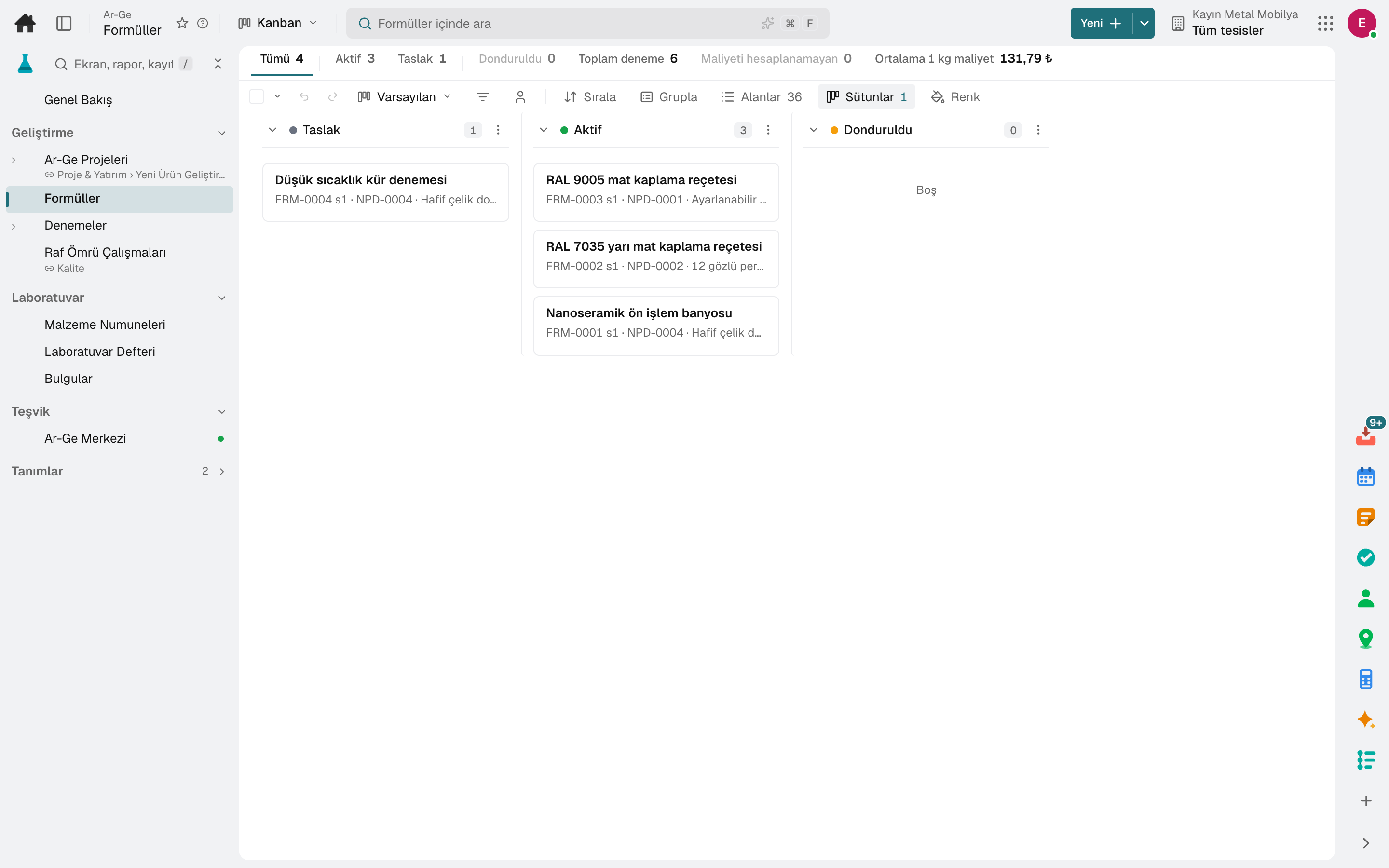
Composition lines and acceptance ranges; batch and per-kilogram cost, nutrition per 100 g and the allergen list are calculated from the sample cards.
Formula versions and acceptance ranges, trials and trial series, a lockable lab notebook, findings, supplier samples and shelf life studies in one app. A new product idea is taken to launch through a stage-gate process.
Roles: R&D specialist
What is it, and why do you need it?
In most businesses product development runs in a spreadsheet and the notebook in the lab: which formula version gave what result in which trial, and what was learned before about a raw material, stay in people's memory.
R&D keeps the formula with its versions, the trial with its purpose and measurement, and the decision with a locked notebook entry. Cost, nutrition per 100 g and the allergen list are calculated from the sample cards; findings come up on the same raw material's card in the next project.
Scope: The product development lab's notebook: formula versions (composition, acceptance ranges, cost, nutrition per 100 g, allergens), trials and trial series (process input, measured output, yield, result), a lockable lab notebook, findings learned, supplier samples and the parameter dictionary; an R&D project is New Product Development itself.
Highlights
Composition lines and acceptance ranges; batch and per-kilogram cost, nutrition per 100 g and the allergen list are calculated from the sample cards.
Every trial is recorded with its purpose, process inputs, measured outputs and yield; measurements are compared with the target and pass or fail, and a new trial is derived from the previous one.
Observations, decisions and meeting notes are kept linked to the trial or formula; a locked entry cannot be changed or deleted, and a mistake is corrected with a correction record.
Lessons, rules and risks from trials are permanent; everything learned about a raw material across all projects reads in one list.
A supplier sample is tracked with its lot, expiry, remaining quantity and unit cost; the shelf life study determines the recommended shelf life from a periodic measurement series.
A new product idea moves through a six-stage stage-gate process; at each gate a score is given and the go or stop decision is recorded.
Sub-modules
This list is generated from the product itself; it grows as new functions are added to a sub-module. Master data and settings are the shared ground of every module and are not counted as sub-modules.
On the same data
Modules are separate screens, but the data is one: a record entered in one module is never re-entered in another.
From order to batch, planned and produced side by side.
From inspection to corrective action, quality on record.
From investment budget to branch opening, every project in one place.
Every product's location, batch and movement at your fingertips.
Frequently asked
Yes. The parameter dictionary and trial templates are industry-independent: you define the inputs and outputs to be measured. Nutrition, allergens and food additive limits are for food producers.
No. A locked entry cannot be changed or deleted; a mistake is corrected with a new entry by opening a correction record, and the chain of entries can be verified.
In Türkiye the certificate, staff and projects of an R&D or design centre are tracked on the R&D Center screen.
Try it free for 15 days; no credit card needed. We reply to your questions within one business day.