Skip to content
Lidyos
Finance & Accounting

Lidyos TreasuryCash and finance management software

See your cash today, and next week from today.

Bank balances, cheques and notes falling due, loan instalments and planned payments come together in one cash position. Loans, factoring, FX transactions and investments are managed in the same place.

  • 6 sub-modules
  • 24 modules at the same price

Industry packages: Lidyos Auto · Lidyos Care · Lidyos Estate · Lidyos Hotel · Lidyos Trade

Industries: Grocery stores, corner shops and greengrocers · Patisseries and bakeries · Hotels and lodging · Real estate and property management · Vehicle and equipment rental

Roles: General manager and board · Finance manager · Accountant · Property and site manager
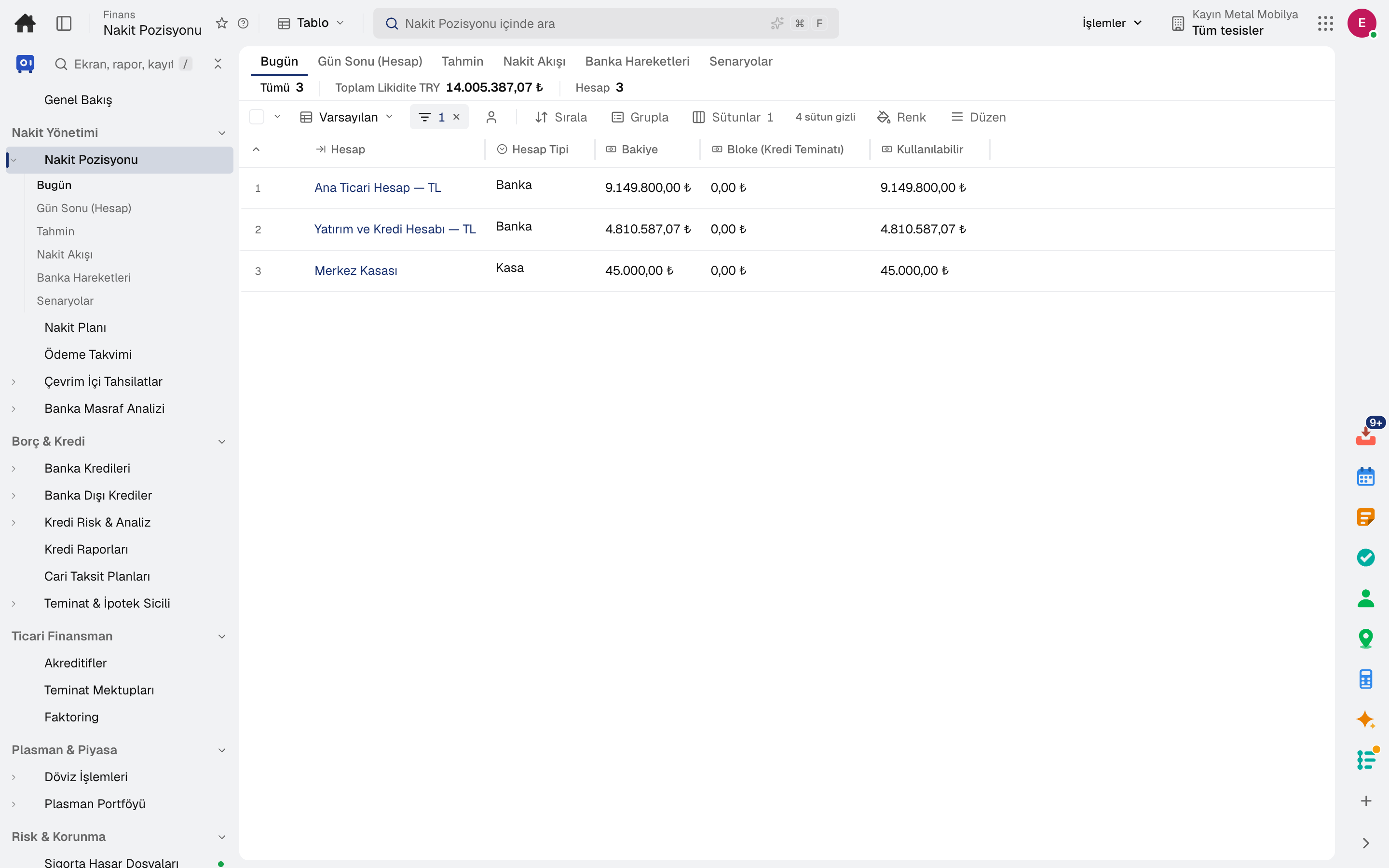
Cash Position
Screen in the product
  • Cash Position

What is it, and why do you need it?

What is Lidyos Treasury for?

A cash squeeze usually starts with a payment you heard about too late: bank balances are in one spreadsheet, the cheque portfolio in another, loan instalments in yet another file. Every morning the finance manager merges them by hand.

Lidyos Treasury reads this data from the source. Open items in accounting, purchasing payments, sales collections and loan schedules flow into the cash position automatically; liquidity is visible daily and weekly, and currency and interest rate risk are measured.

Scope: Manages finance operations such as loans, cheques and notes, cash position, foreign exchange and investments.

Highlights

What can you do with Lidyos Treasury?

01

Cash position and plan

Daily cash position from bank balances and expected collections and payments; the payment calendar shows due dates in advance.

02

Bank loans

Loan agreements, instalment plans, collateral and mortgage register, credit risk analysis and reports; factoring transactions included.

03

FX and market data

ECB and TCMB rates arrive automatically; FX deals and derivatives are on record.

04

Cash pooling and netting

Cash pooling groups, in-house banking and netting for group companies; bank fee analysis.

05

Risk and hedging

Market and counterparty risk measurement, IFRS 9 hedge accounting relationships, investment portfolio and equity holdings.

06

Letters of credit and supplier finance

Import and export letters of credit, the supplier finance programme with the bank and non-bank loans are tracked in the same place.

07

Letters of Guarantee

Letters of guarantee received and given are tracked with their commission periods, return and call; the commission lands in the payment calendar, and a letter given is deducted from the bank's non-cash limit.

08

Non-bank loans

Loans taken from or given to a shareholder, an employee or another company, and loans between group companies; a repayment plan is produced with principal, interest and day count.

09

Insurance claim files

The file for a loss that hits an insured asset: the policy covering the date of loss is found automatically, and the deadline for notifying the insurer is calculated.

Sub-modules

Lidyos Treasury: 6 sub-modules

This list is generated from the product itself; it grows as new functions are added to a sub-module. Master data and settings are the shared ground of every module and are not counted as sub-modules.

Cash Management

  • Cash PositionShows bank and cash balances as today's cash position (foreign-currency accounts converted to the company's currency), the end-of-day forecast per account and the funding of an account that would go negative; the liquidity forecast comes from a single engine with day, week or month buckets (sources: invoices · loans · placements · payroll · rent), with how well it held in past weeks and its statistical trend; in the Scenarios section the budget is compared per category with actuals taken from bank movements.
  • Cash PlanAdds expected cash inflows and outflows that are not yet posted to accounting as cash plan records.
  • Payment CalendarShows all payments (loan instalments, cheques, promissory notes, purchase invoices, rent, subscriptions, salaries, tax/SGK, card statements, cash plan …) on a single calendar by due day; overdue items are red.
  • Online CollectionsTracks all online card payments made by customers (register link, QR, form, portal, event, rental, hotel, reservation, rent) in a single list; shows the record the payment belongs to, the card, the fraud result and chargebacks; queries a payment that was not posted to its record, has it posted or refunds it to the card.
  • Cash Pooling GroupsConsolidates bank accounts into a currency-based cash pool; opens a transfer suggestion with a master account and zero/target balance rule — money moves when the suggestion is approved.
  • Bank Charge AnalysisCompares the fee, commission and BSMV items in bank statements in a bank/account × category × month pivot with the previous period and with the tariff agreed with the bank (each month the tariff valid for that month; by bank or by account).

Loans & Debt

  • LoansRecords and tracks bank loans with their interest and repayment terms; bank limits, operations and compliance tasks are sections of the same screen. Early closure and refinancing preview are loan actions.
  • Non-Bank LoansThe contract for debt that does not come from a bank: a loan we take from or give to a shareholder, an employee or another person or company, and loans between group companies. A payment plan is produced with principal, interest and day count; for a shareholder and a group company the interest is compared with a benchmark (transfer pricing, Corporate Tax Law art. 13), and VAT and withholding tax on the interest are tracked separately. With a business partner, the drawdown and every instalment post a voucher with the partner to our ledger and a movement to our bank account; with a group company, to the ledgers of both companies; the last transaction can be undone.
  • Loan Risk & AnalysisMonitors the loan portfolio's contractual covenants, covenant breaches and guarantor risk, and runs portfolio stress scenarios; the Loan Calculator in the header calculates the repayment schedule, effective interest rate (EIR), internal rate of return (IRR) and day count without writing any record.
  • Loan ReportsProduces the loan portfolio as the selected report: aging, creditor summary, cash flow forecast, interest cost, interest trend, delinquency, upcoming maturities, foreign currency valuation and finance expense limitation.
  • Instalment PlansSplits a business partner/invoice debt into installments; the line item payment is posted to the ledger from the selected account with a Z22 voucher.
  • CollateralsRecords and tracks collateral and guarantees linked to loans.

Trade Finance

  • Letters of CreditTracks import and export letters of credit with bank, amount, tolerance and dates: amendments, document presentation (discrepancies), payment/acceptance and charges; an open import letter of credit is deducted from the bank's non-cash limit.
  • Letters of GuaranteeRecords and tracks letters of guarantee received from banks or given to counterparties: off-balance-sheet entry, commission periods (fed into the Payment Calendar), return, call and closing of the off-balance-sheet entry; an issued letter draws on the bank's non-cash credit limit.
  • FactoringManages the assignment and collection of receivables through factoring.
  • Supplier FinanceSupplier finance (reverse factoring) programme with your bank: approved supplier invoices are added to the programme (with a payment block), the supplier asks for early payment from the portal and is paid with a discount priced on your credit rating; when the bank funds it the invoice closes and the payable moves to the bank, which debits your account at maturity. Limit, the IFRS 7 disclosure and bulk actions.

Investments & Markets

  • FX DealRecords and tracks foreign exchange (FX) buy/sell transactions.
  • DerivativesRecords derivative instrument transactions such as forwards, swaps and options.
  • PortfolioTracks deposit, repo and bond investments with their maturity, interest and yield. For rows whose source document is a money market transaction, the actions of confirmation · accrual · maturity · reversal · early closure are also performed from here; the “MM Snapshot” tab keeps a dated snapshot of the portfolio. The master data and positions of securities such as bonds and shares are part of the same screen.
  • Equity InvestmentsTracks shares in associates and subsidiaries together with their impairment provisions.

Risk & Hedging

  • Market & Counterparty RiskMeasures the market risk of treasury positions (VaR, interest rate repricing gap) and counterparty credit limit utilization.
  • Hedge Accounting (IFRS 9)Accounts for hedging transactions as hedge relationships under IFRS 9: relationships, effectiveness test, OCI accumulation and documentation.
  • Insurance ClaimsThe insurance file for a loss hitting an insured asset: machine breakdown, fire, flood, power surge; frost, hail, flood and storm on a parcel; animal death or disease. The policy covering the day of damage is found automatically from the damaged party's insurance asset (the fixed asset for a machine, the parcel or animal in agriculture), and the last day to notify the insurer is written by the rule of the source (working days for a machine, calendar days in agriculture); notification, surveyor, repair quote and claim are tracked, documents are uploaded to the record, and the official notification is reminded when an animal dies. Compensation received is posted to the ledger: for a machine it is deducted from the maintenance cost, for a parcel it enters the season's profit. Service damage to a customer's goods and return damage to rented goods are not insurance files and stay on their own screens.

Intercompany Financing

  • In-House CashRuns the in-house bank accounts of group companies: intercompany payments and transfers, interest run, netting.

Setup master data and settings

  • Market DataShows market data with its sources: CBRT rates and the ECB comparison, €STR · SOFR · TLREF benchmark rates, EVDS indicators and the status of the sources.
  • Liquidity SettingsMaintains the definitions for liquidity planning: planning levels, risk/maturity groups (Cash Flow categories) and classification rules that link bank transactions to a category.
  • Loan SettingsDefines loan product types, interest day-count methods and the reference indices of floating interest.

Frequently asked

About Lidyos Treasury

How do bank transactions come in?

Bank statements are brought into the platform; bank reconciliation in Financial Accounting matches the transactions with the records.

Can we net between group companies?

Yes. In-house banking and netting reduce intercompany payables and receivables to a single payment; cash pooling groups show balances together.

Where are cheques and notes tracked?

The negotiable instruments portfolio is kept in Financial Accounting; due dates flow into the cash position and payment calendar automatically.

Close next month end without a reconciliation marathon.

Try it free for 15 days; no credit card needed. We reply to your questions within one business day.